

Building Independent Ecommerce Stores: Why Store Isolation Matters
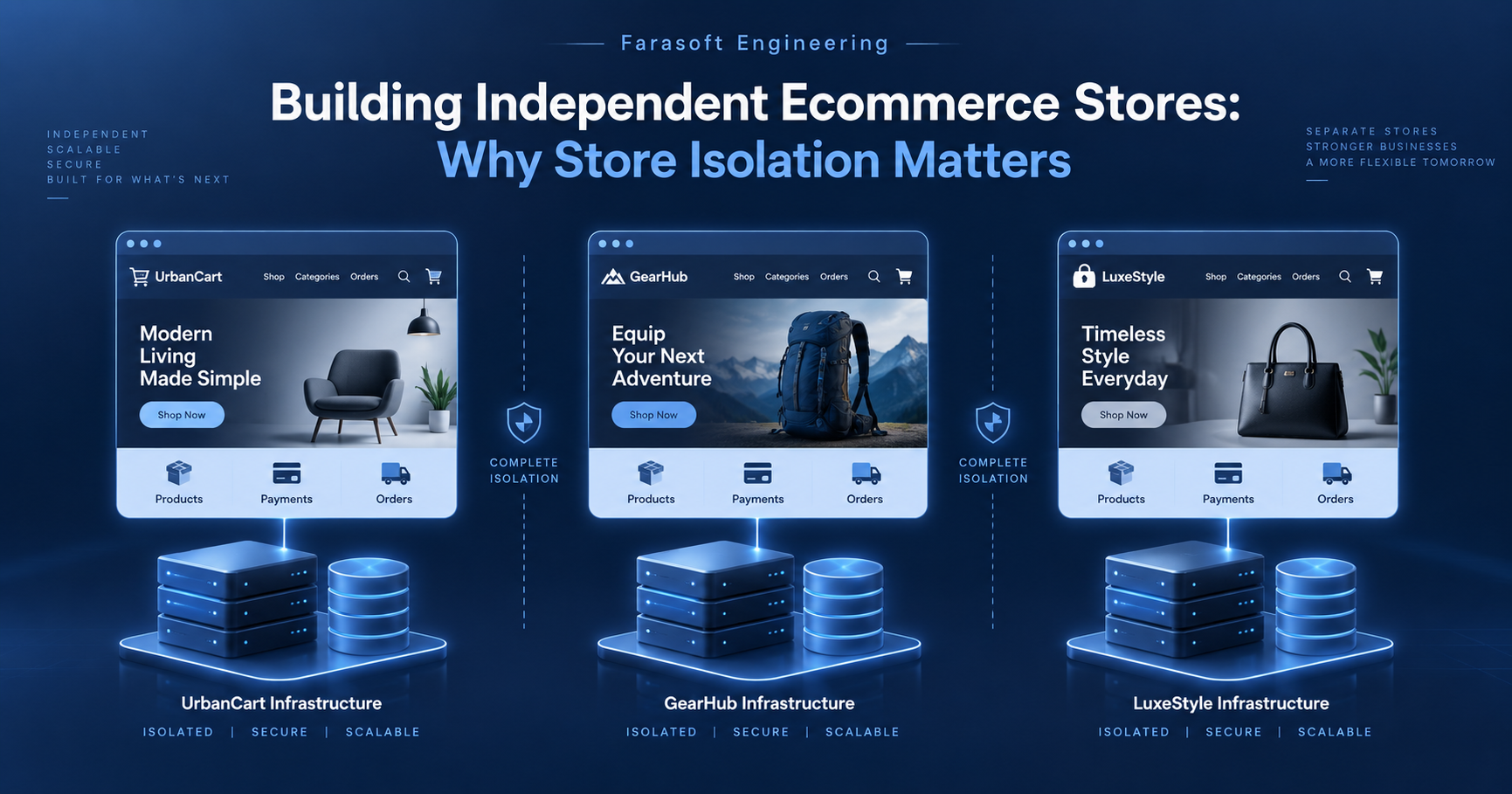
Building Independent Ecommerce Stores: Why Store Isolation Matters
When businesses think about launching an online store, the first questions are usually about design, products, payments, and shipping.
But there is another decision that can have a much bigger impact in the long term:
How is each store actually isolated inside the ecommerce platform?
For a small project, this may not seem important.
As the number of stores, customers, orders, integrations, and updates grows, however, the architecture behind each store becomes increasingly important.
A well-designed ecommerce platform should not only make it easy to create a storefront. It should also provide a reliable foundation for running the business behind that storefront.
What does store isolation mean?
Store isolation means that each ecommerce store operates as an independent service boundary rather than simply being another set of records mixed into the same application environment.
Depending on the platform architecture, this can include separation of:
Data
Files
Store configuration
Business settings
Customers
Products
Orders
Payment information
Inventory
Store identity
Public domain configuration
The goal is simple:
A problem, customization, or operational change in one store should not unnecessarily affect another store.
Why does this matter in ecommerce?
An online store contains much more than a product catalog.
It continuously processes business-critical information.
Customers create accounts.
Products change price.
Inventory changes after sales.
Payments succeed or fail.
Orders move through different fulfillment stages.
Shipping information is updated.
Staff members access different parts of the administration panel.
All of these operations create state.
When many businesses depend on the same ecommerce platform, the architecture must ensure that this state remains predictable and properly separated.
Data integrity becomes more important as the platform grows
Imagine a platform hosting only two small stores.
A simple architecture may appear completely sufficient.
Now imagine the same platform serving hundreds or thousands of businesses.
Each one may have its own:
Products
Customers
Prices
Inventory
Orders
Payment providers
Shipping configuration
Staff permissions
Business rules
At that scale, accidental data crossover becomes a serious architectural risk.
Good isolation reduces the number of places where one store can unintentionally affect another.
This makes the system easier to reason about, test, maintain, and audit.
Inventory is a good example
Inventory looks simple until multiple sales channels become involved.
Consider a retailer that sells through both a physical location and an online store.
A customer buys the last unit of a product in the physical shop.
If the ecommerce system still shows the product as available online, another customer may successfully place an order for stock that no longer exists.
Now multiply this problem across hundreds of products and many stores.
Inventory is no longer just a number in a database.
It becomes part of a larger operational system connecting products, orders, physical sales, online sales, and reporting.
This is one reason ecommerce architecture should be designed around business operations rather than only storefront presentation.
Orders need clear ownership
Orders are another area where isolation matters.
An order belongs to a specific business.
That order may contain information about:
The customer
Products
Pricing
Discounts
Payment
Shipping
Status history
Fulfillment
Staff activity
Returns
Reporting
The system should always have a clear and authoritative relationship between that order and the store that owns it.
As integrations are added, this becomes even more important.
Payment gateways, shipping services, analytics systems, marketplaces, and external APIs all interact with store-specific data.
Clear store boundaries make those integrations safer and easier to maintain.
Independent stores simplify operational reasoning
One of the biggest advantages of isolation is not visible to the customer.
It is visible to the engineering and operations teams.
When a store has a clear service identity, it becomes easier to answer questions such as:
Which configuration belongs to this business?
Which database contains its operational data?
Which domain is connected to the store?
Which version of the application is running?
Which payment configuration is active?
Which files belong to the business?
Which update affected the store?
These questions become increasingly important during debugging, migration, deployment, and incident response.
Updates should not create unnecessary risk
Ecommerce platforms evolve constantly.
New payment methods are added.
Shipping services change.
Search behavior improves.
Security patches are released.
Storefront designs evolve.
Administration tools gain new capabilities.
A platform therefore needs a reliable update strategy.
If the system is highly coupled, a change intended for one part of the platform can create unexpected behavior elsewhere.
Store isolation does not eliminate every deployment risk, but it creates clearer boundaries for testing, provisioning, updating, and recovering individual stores.
Store identity matters too
A business usually wants its ecommerce store to feel like its own property.
That includes more than visual branding.
A store may have its own:
Domain
Catalog
Customers
Business settings
Payment configuration
Shipping rules
Content
SEO configuration
Analytics
Staff accounts
Operational history
From the business owner's perspective, these components together form the digital identity of the store.
The underlying architecture should reflect that ownership clearly.
Isolation and scalability are related
Scalability is often described only in terms of traffic.
Can the application handle more visitors?
That is important, but ecommerce scalability also means supporting more businesses without making the platform increasingly fragile.
A scalable commerce architecture should make it possible to add stores while keeping operational complexity under control.
The system should remain understandable as the number of tenants grows.
Isolation helps establish predictable boundaries between businesses and makes future infrastructure decisions easier.
What about shared multi-tenant systems?
Multi-tenant architecture is not inherently bad.
Many successful SaaS platforms use shared infrastructure.
The important question is how tenant boundaries are implemented.
A carefully designed shared system can provide strong logical isolation.
A poorly designed system can create excessive coupling.
Likewise, independent store instances provide advantages only when provisioning, deployment, monitoring, and updates are properly automated.
There is no universal architecture that is correct for every ecommerce platform.
The architecture should match the business model, operational requirements, expected scale, and level of customization.
Why we chose independent store instances at Farasoft
At Farasoft, we treat each customer store as an independent store instance.
The objective is to maintain clear separation between businesses while still allowing the platform to provision, manage, and update stores centrally.
This architecture supports the broader idea that an ecommerce store is not simply a collection of pages.
It is an operational system containing products, inventory, customers, orders, payments, shipping, reporting, and business configuration.
The Farasoft ecommerce platform is designed around this approach, with each store maintaining its own service identity while being managed through the wider Farasoft platform infrastructure.
Ecommerce architecture should support the business, not limit it
Architecture decisions made at the beginning of an ecommerce project often become difficult to change later.
That is why infrastructure should be evaluated not only for what a business needs today, but also for what may happen when the business grows.
More products may be added.
More staff members may need access.
A physical store may be connected.
New payment providers may be introduced.
Shipping integrations may change.
Traffic may increase.
New sales channels may appear.
The underlying ecommerce system should be able to support those changes without forcing the business to rebuild its entire operational foundation.
Final thoughts
A successful ecommerce platform needs more than an attractive storefront.
It needs a reliable operational architecture.
Store isolation can help create clearer ownership of data, safer integrations, more predictable deployments, and a stronger foundation for future growth.
For businesses, most of this architecture should remain invisible.
They should simply be able to manage products, inventory, customers, orders, payments, shipping, and sales without worrying about the infrastructure underneath.
For platform engineers, however, those invisible architectural decisions are exactly what make that experience possible.
About Farasoft
Farasoft is an ecommerce platform focused on independent online stores and integrated commerce operations, including product management, inventory, customers, orders, payments, shipping, POS, reporting, and store infrastructure.